Q2 Box Office Outlook and Q1 Streaming Update
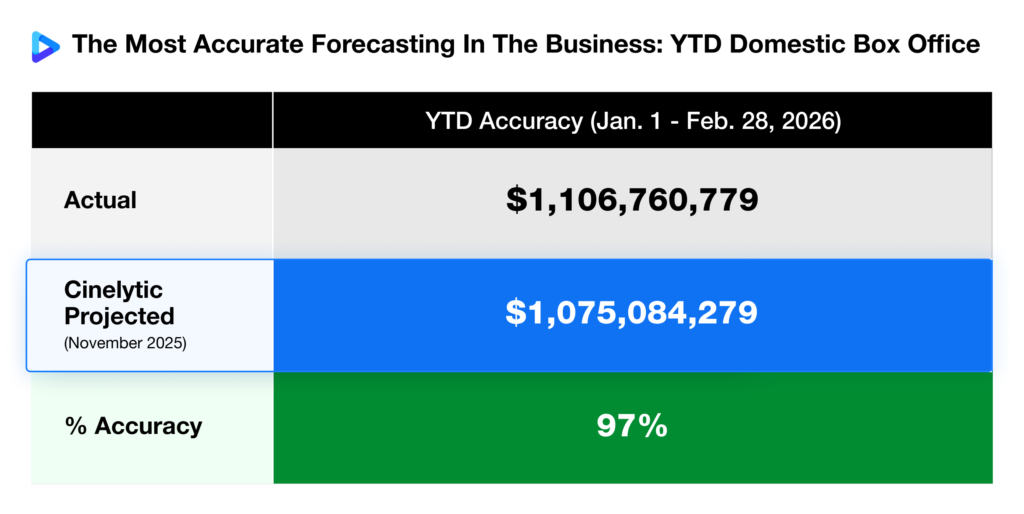
Throughout the year we will continue tracking the performance of the domestic box office (DBO) projections we developed at the end of 2025 and published this past January for the 2026 film slate. As illustrated in the graphic below, through the first two months of the year Cinelytic’s forecasts achieved an impressive 97% accuracy rate:
How Does Q2 Look?
Looking ahead, the theatrical slate in Q2 will largely shape the streaming landscape for mid-2026. Consistent with the forecasting approach we provide, the chart below highlights our projection for Q2 2026 DBO, which currently indicates a modest decline of roughly 8% in comparison to Q2 2025:
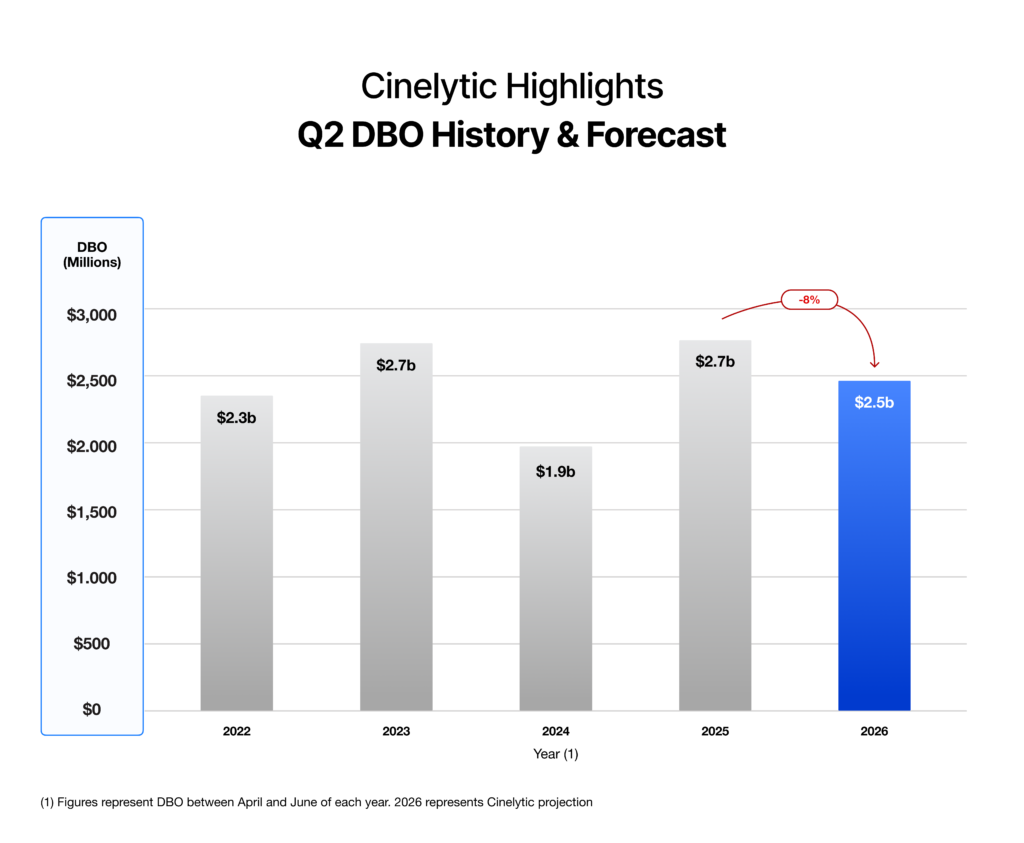
At first glance, it may seem unusual to see an approximately 8% decline in the Q2 forecast year over year, particularly given that we projected 2026 to reach a total of around US$9.6b, which would mark the strongest overall DBO since 2019. However, the comparison is largely influenced by the exceptionally strong performance of Q2 2025, which benefited from several titles that significantly outperformed expectations.
Films such as A MINECRAFT MOVIE, SINNERS, LILO AND STITCH, and F1 all delivered results well above early projections. Those overperformers created a particularly high benchmark that makes the 2026 projection of about US$2.47b appear softer despite still representing a healthy seasonal performance.
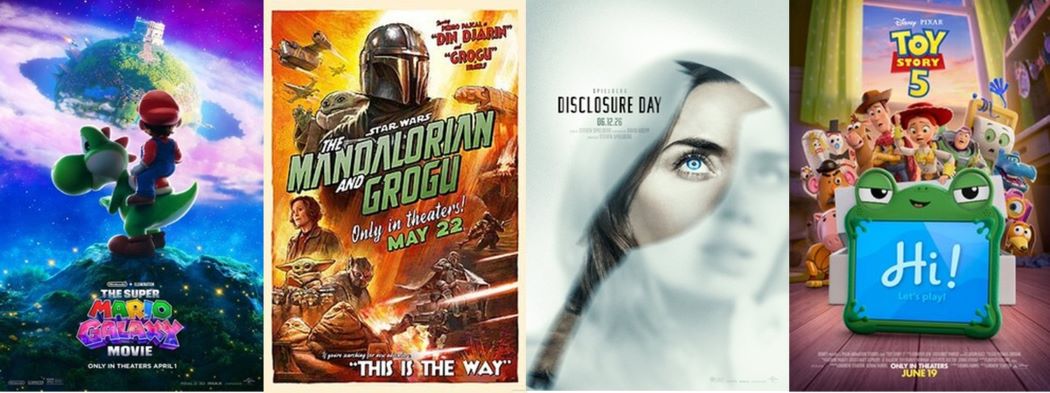
Importantly, Q2 2026 still includes several releases expected to rank among the highest grossing titles of the entire year, including THE SUPER MARIO GALAXY MOVIE, THE MANDALORIAN AND GROGU, and TOY STORY 5. The quarter is also supported by additional high-profile titles such as Antoine Fuqua’s biopic MICHAEL, the long awaited THE DEVIL WEARS PRADA 2, MORTAL KOMBAT 2, SUPERGIRL, and Steven Spielberg’s UFO thriller DISCLOSURE DAY.
Q1 Streaming Performance
With the theatrical outlook in mind, it is also worth assessing how major recent releases have performed once they reached the digital window. Using our proprietary streaming demand data which tracks 125m daily peer-to-peer (P2P) transactions worldwide and roughly 35b annually, we evaluated the first seven days of digital performance for six major late-2025 and early-2026 theatrical releases: ANACONDA, MARTY SUPREME, GREENLAND 2: MIGRATION, 28 YEARS LATER: THE BONE TEMPLE, MERCY, and SHELTER:
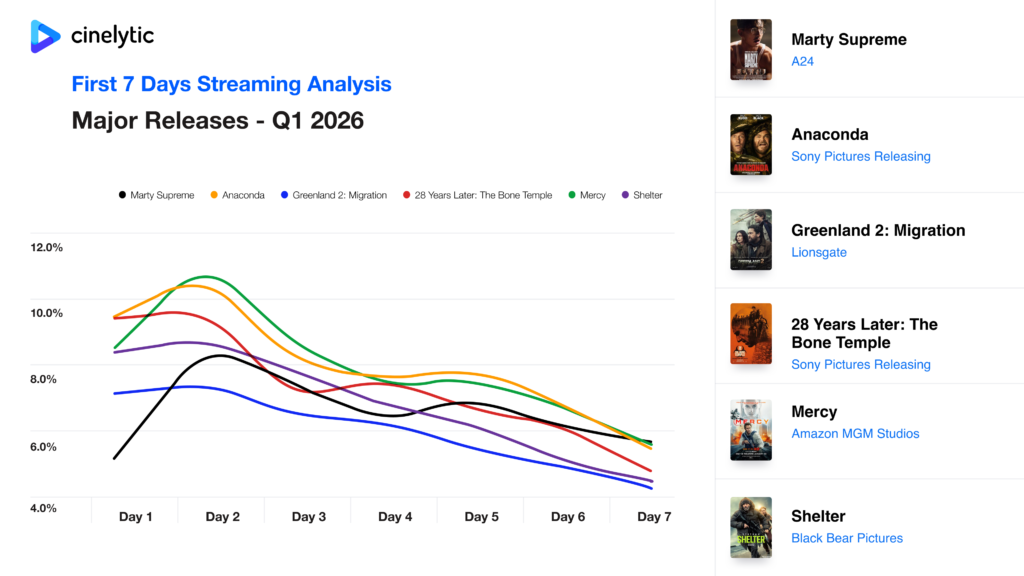
ANACONDA delivered the strongest performance, averaging 8.1% viewing market share capture against all competing and available titles, and peaking above 10% on Day 2 before gradually declining throughout the week. The recognizable legacy IP combined with a beloved lead comedic cast and creature feature premise likely contributed to both strong theatrical awareness and continued streaming engagement.
MERCY performed nearly identically with an 8.0% weekly average and a Day 2 peak just over 10%. Despite being critically panned and underperforming theatrically worldwide, the combination of a familiar action thriller concept and Chris Pratt’s star power encouraged audiences to give the film a chance once it arrived on streaming.
28 YEARS LATER: THE BONE TEMPLE averaged 7.4% across the week after opening near 9.5% on Day 1. As the only title tied to a major franchise, early streaming interest was expected. However, the film significantly underperformed theatrically relative to its predecessor, which was released just seven months ago. The short gap between installments may have led some audiences to feel the follow-up arrived too soon, opting instead to wait and watch it at home.
The remaining titles formed a second grouping. MARTY SUPREME averaged 6.7%, peaking above 8% on Day 2 before steadily declining. As the highest grossing A24 release driven by Timothée Chalamet’s star power and one of the most aggressive marketing campaigns in recent memory, much of the audience likely rushed to see the film in theaters, leaving less immediate demand for home viewing.
SHELTER averaged 6.9% and maintained relatively steady engagement before tapering late in the week. While the film underperformed in theaters relative to typical Jason Statham action releases, that style of straightforward action often performs well on streaming where audiences gravitate toward familiar and easily watchable titles.
Finally, GREENLAND 2: MIGRATION recorded the lowest weekly average at 6.1%. Arriving six years after the original with minimal marketing and releasing the same day on streaming as ANACONDA, the film struggled to generate the same level of attention both in theaters and at home.
All to Say
Taken together, these early indicators highlight the evolving balance between theatrical and streaming performance. While 2025 proved to be a challenging year, and Q2 2026 is currently projected to show modest year-over-year decline, the broader trajectory remains positive.
At the same time, streaming performance demonstrates that films which fall short theatrically can still generate meaningful audience engagement once they reach the home window. Titles such as 28 YEARS LATER: THE BONE TEMPLE and MERCY illustrate how recognizable IP or star power can drive strong digital viewing even after underwhelming theatrical runs. Others, like ANACONDA, occupy a middle ground, performing solidly at the box office relative to budget while also sustaining strong digital engagement.
Conversely, certain films achieve the majority of their audience during the theatrical window itself. MARTY SUPREME, driven by awards buzz and strong pre-release momentum, concentrated much of its demand in theaters, leaving less residual demand for repeat viewing on streaming, especially due to its 149-minute runtime. And as always, some titles struggle to find a meaningful audience across either window, as seen with GREENLAND 2: MIGRATION and SHELTER. In short, while theatrical performance remains the primary indicator of industry health, streaming data increasingly reveals where audience demand ultimately settles. Together, these windows reinforce the broader takeaway for 2026: even in quarters where box office growth appears modest or temporarily soft, total audience engagement across platforms continues to support what we already predicted will be strongest theatrical year since the pre-pandemic era.